For research use only. Our products are not intended for human or animal diagnosis, treatment or prevention, and are not for ingestion.
Free US shipping over $150 · Weekday orders placed before 15:00 EST ship the same day · Third-party reports with every batch
Peptide Science
From amino acid chain to test report: the science and data behind the vial in your hand.
Basics
What is a peptide
Amino acids join end to end through peptide bonds (—CO—NH—) to form chain molecules. Short chains of 2–50 residues are usually called peptides; longer chains are classed as proteins.
That length range matters: short enough to synthesize precisely and measure mass accurately, yet long enough to form defined spatial structure and bind receptors or enzymes selectively.
- Sequence defines properties: the order from N-terminus to C-terminus determines molecular weight, isoelectric point and secondary-structure propensity.
- Precise synthesis: solid-phase synthesis can build sequences of dozens of residues, and batch variation can be controlled chromatographically.
- Readily degraded: proteases are abundant in vivo, which is the origin of the short half-life characteristic.
Research Directions
Common research directions
The categories below are common in the literature and are provided as scientific background only.
⚡Metabolism and energy regulation
Covers insulin signalling, the GLP-1 pathway, energy metabolism and mitochondrial function, typically in cell metabolism models and receptor mechanism studies.
🧠Neuroscience and cognition
Includes neurotrophic factor expression, neural plasticity and behavioral models, focusing on how peptides act in the central environment.
🛡️Immune regulation
Examines peptide interactions with immune-cell surface receptors, changes in cytokine expression and differing responses in inflammation models.
🩹Tissue repair
Centers on cell migration, angiogenesis and extracellular matrix remodelling — the main research direction for products such as BPC-157, TB-500 and GHK-Cu.
Why Peptides
Why research peptides are widely used in mechanism studies
Compared with small molecules, peptides generally offer a larger contact area and a better-defined binding interface, making them easier to design against a single receptor or a specific protein–protein interaction, with less background interference.
The control that a short half-life provides
Most natural peptides are rapidly degraded in vivo. That looks like a drawback, but in experimental design it means the stimulus is brief and can be terminated — researchers can vary dosing intervals and sampling points to observe dynamic responses rather than a continuously saturated state.
This is also why many studies run the long-acting DAC version and the short-acting non-DAC version side by side as controls.
Testing Workflow
From sample submission to COA
Every batch must complete the four steps below; failure at any step rejects the whole batch.
Third-party sample submission
Samples are shipped from our warehouse straight to an independent testing laboratory, so internal handling cannot affect representativeness.
Third-party sample submission
Samples are shipped from our warehouse straight to an independent testing laboratory, so internal handling cannot affect representativeness.
HPLC purity analysis
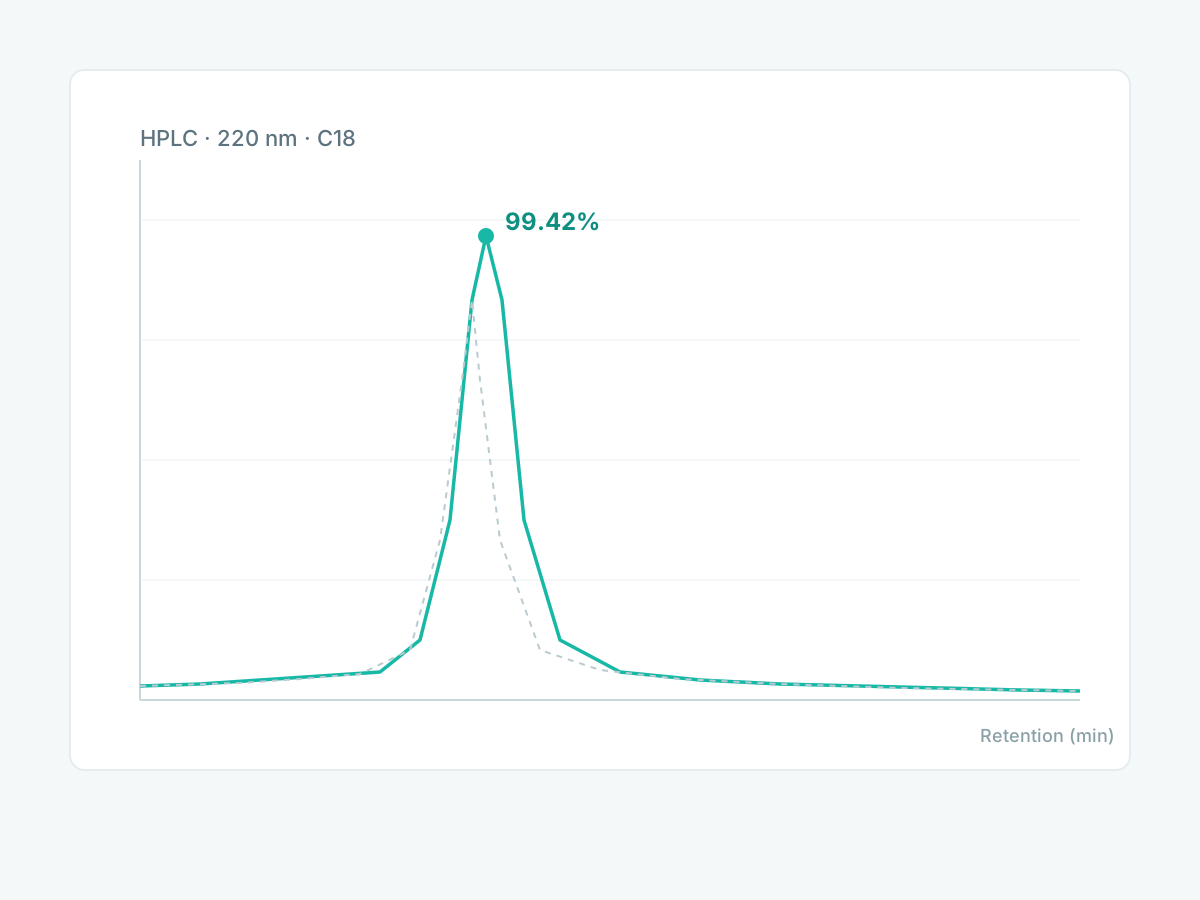
Separation on a C18 reversed-phase column with UV detection at 220 nm. Purity is calculated from main-peak area percentage, with a release standard of ≥ 99%.
LC-MS identity confirmation
Electrospray ionization mass spectrometry measures the mass, which is compared with the value calculated from the theoretical sequence; deviation must be under 0.1%.
Report archived and published
Purity, mass, test date and conclusion are consolidated into a unique report number, bound one-to-one to the vial batch number.
🔬 Amino acid analysis
Selected batches undergo amino acid composition analysis to confirm the measured composition matches the theoretical sequence, revealing missing or substituted residues.
🧪 Endotoxin testing
For cell-based work, sampled endotoxin testing is performed and published with the COA, so you can judge suitability for direct use in culture systems.
💧 Moisture and residuals
Lyophilized batches are checked for residual moisture and organic solvent, kept within sensible limits to preserve stability after reconstitution.
Reading a COA
How to read a batch COA
A COA is not a certificate of approval — it is a data record you can check. On receiving a sample, we suggest verifying in this order:
- Check the batch number first: the batch number on the report must match the vial label exactly — prefix, digits and letters.
- Then the test date: the date should be later than the production date and usually no more than 12 months old.
- Check the purity figure: the report should state a specific percentage and the integration method, not merely "pass".
- Check the molecular weight: the LC-MS measured mass should be close to the theoretical value, with the main peak annotated on the spectrum.
- Confirm the issuing laboratory: the report should carry the laboratory name and signatory, and the corresponding entry can be found on the COA Reports page.
⚠️
All research peptides are for laboratory use only. We do not answer questions about dosage, administration routes or effects in humans, and cannot offer advice on them.
Bring the batch number and check the data
HPLC chromatograms and LC-MS results for every batch on sale are public — enter a name or batch number to view them.